
Most lifters obsess over sets, macros, and supplements — then ignore the one variable quietly capping their results: stress. The connection between stress and muscle growth is more direct than most lifters realize: when life stress runs high, your body stays flooded with cortisol, a hormone that actively works against muscle growth. The science here is surprisingly direct: stressed lifters recover slower and build less muscle from the exact same training. Here’s how cortisol sabotages your gains, what the research actually shows, and how to keep stress from stealing your progress.
What Cortisol Actually Does to Your Muscles
Cortisol is your body’s main stress hormone. In short bursts, it’s useful — it frees up energy so you can handle a threat. The problem is chronic elevation. When cortisol stays high, it tips your body into a catabolic (breakdown) state: it accelerates the breakdown of muscle protein through the ubiquitin–proteasome pathway while simultaneously blunting protein synthesis. In plain terms, high cortisol tears muscle down faster and rebuilds it slower — the exact opposite of what you want after a workout.
Good Stress vs. Bad Stress
Not all stress is bad. Training itself is a stressor — a deliberate one. A hard session spikes cortisol acutely, and that’s part of the adaptation signal: you stress the muscle, recover, and come back stronger. That’s “good” stress — short, sharp, and followed by recovery.
The trouble starts when stress is chronic and unrelenting: work deadlines, poor sleep, money worries, and relationship strain. Your nervous system never gets the “all clear.” Cortisol stays elevated, and that background stress stacks on top of your training stress. Researchers describe stress and exercise recovery as tightly linked — the more life stress you carry, the less capacity you have to absorb and recover from training.
The Proof: Stress Slows Real-World Gains
This isn’t just theory. In a 12-week study of 135 trainees, those reporting high life stress gained significantly less strength in the bench press and squat than low-stress trainees following the same program. Same effort, worse results — the main difference was stress.
A separate study found that highly stressed lifters recovered muscular function more slowly in the hour after a hard resistance workout, and reported more fatigue and less energy. Stress doesn’t just feel bad; it measurably blunts both your short-term recovery and your long-term gains.
The Stress–Sleep–Recovery Spiral
Stress rarely acts alone. High stress wrecks sleep, and poor sleep raises cortisol even further — a self-feeding loop. Just one week of sleep restriction has been shown to drop testosterone in healthy young men by 10–15%, shifting your hormonal balance away from building muscle. Less sleep means more cortisol and less testosterone, which slows recovery, which makes you feel more stressed — and the spiral continues. Breaking it usually starts with protecting your sleep. For the full breakdown, see our guide on how sleep builds muscle.
Stress and Muscle Growth: How to Manage It for Better Gains
You can’t eliminate stress, but you can stop it from capping your gains. The fundamentals do most of the work:
- Protect your sleep. 7–9 hours on a consistent schedule. This is the single biggest lever.
- Program deloads. Every 4–8 weeks, pull back volume and intensity for a week so training stress doesn’t pile up.
- Move gently on rest days. Walking and easy cardio lower cortisol; piling on more hard training does the opposite.
- Breathe and downshift. Even 10 minutes a day of slow breathing, meditation, or time outdoors helps switch off the stress response.
- Eat enough. Chronic under-eating is itself a stressor that raises cortisol — don’t crash-diet and train hard at the same time.
These habits are 90% of the answer. A supplement can fill a specific gap — and for stress, one option has real evidence behind it. In a 60-day placebo-controlled trial, 600 mg/day of KSM-66 ashwagandha significantly lowered serum cortisol and reduced perceived-stress scores. It won’t fix a chaotic lifestyle, but if stress is your bottleneck, it’s the most research-backed tool available. (For more options, see our full roundup of the best sleep and recovery supplements.)
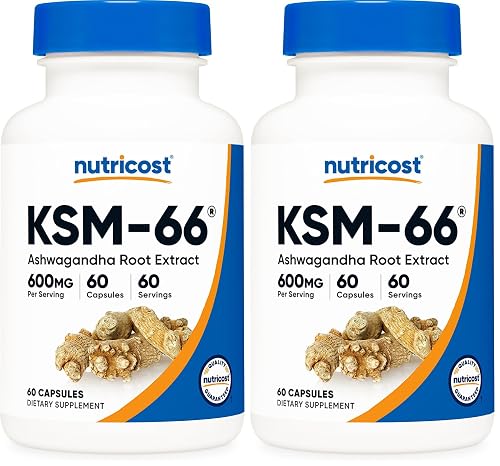
KSM-66 is the most-studied ashwagandha extract, and the 600 mg dose Nutricost uses matches the clinical trials that showed lower cortisol and reduced stress. It’s a tool for the stress problem specifically — not a mass-builder, but the most evidence-backed option if a racing mind is what’s capping your recovery.
Best for: Lifters whose progress is bottlenecked by chronic stress, anxiety, or poor sleep from an over-revved nervous system.
Check Price on Amazon →The other supplement worth a look is magnesium. Stress quietly burns through your magnesium stores, and being low on magnesium makes your body more reactive to stress — a genuine vicious circle. Magnesium glycinate is the most absorbable form and pulls double duty: it calms an over-revved nervous system and supports the deep sleep your muscles recover in.

Glycinate is the gentlest, most absorbable form of magnesium — the mineral that quiets a wired nervous system and relaxes muscles before bed. Since stress drains your magnesium stores, topping them back up helps break the stress-depletion loop and supports the deep sleep recovery depends on. Clean, USP-verified, no megadose.
Best for: Anyone whose stress shows up as muscle tension, restlessness, or trouble winding down at night.
Check Price on Amazon →Frequently Asked Questions
Does cortisol always hurt muscle growth?
No. Acute cortisol spikes from training are normal and even part of adaptation. It’s chronically elevated cortisol — from ongoing life stress and poor sleep — that works against you.
Will lowering stress alone build muscle?
No. Managing stress removes a brake on your progress, but you still need progressive training, enough protein, and recovery. See our science-backed guide to gaining muscle for the full picture.
Do I need a supplement to manage stress?
No. Sleep, deloads, easy movement, and eating enough handle most of it. Ashwagandha is an optional add-on if stress is genuinely your limiting factor.
Can overtraining raise cortisol, too?
Yes. Training is a stressor, and too much volume with too little recovery keeps cortisol elevated. That’s exactly what deload weeks are for.
Want More Guides Like This?
Get evidence-based supplement & training tips delivered straight to your inbox. No spam, unsubscribe anytime.
The Bottom Line
When it comes to stress and muscle growth, stress is the silent variable sitting between your effort and your results. Chronically high cortisol breaks muscle down, blunts protein synthesis, wrecks your sleep, and — as the research shows — measurably slows both recovery and strength gains. You don’t need a perfectly calm life to grow, but you do need to keep chronic stress in check: sleep well, deload, move easy, eat enough, and lean on ashwagandha only if stress is your real bottleneck. Train hard, then actually let your body recover. That’s when the muscle gets built.
References
- Stults-Kolehmainen MA, Bartholomew JB. Psychological stress impairs short-term muscular recovery from resistance exercise. Med Sci Sports Exerc. 2012;44(11):2220–2227.
- Bartholomew JB, Stults-Kolehmainen MA, Elrod CC, Todd JS. Strength gains after resistance training: the effect of stressful, negative life events. J Strength Cond Res. 2008;22(4):1215–1221.
- Stults-Kolehmainen MA, Sinha R. The effects of stress on physical activity and exercise. Sports Med. 2014;44(1):81–121.
- Hasselgren PO. Glucocorticoids and muscle catabolism. Curr Opin Clin Nutr Metab Care. 1999;2(3):201–205.
- Chandrasekhar K, Kapoor J, Anishetty S. A prospective, randomized double-blind, placebo-controlled study of safety and efficacy of a high-concentration full-spectrum extract of ashwagandha root in reducing stress and anxiety in adults. Indian J Psychol Med. 2012;34(3):255–262.
- Leproult R, Van Cauter E. Effect of 1 week of sleep restriction on testosterone levels in young healthy men. JAMA. 2011;305(21):2173–2174.
- Pickering G, Mazur A, Trousselard M, et al. Magnesium status and stress: the vicious circle concept revisited. Nutrients. 2020;12(12):3672.
Disclosure: As an Amazon Associate, I earn from qualifying purchases. This means if you click on a link and make a purchase, I may earn a small commission at no extra cost to you.