
Your joints take a beating long before your muscles start complaining. Collagen makes up most of your tendons, ligaments, and cartilage — and natural production drops roughly 1% a year after your mid-20s.
Supplementing with hydrolyzed collagen peptides won’t undo an old injury, but the research does support it for joint comfort, skin elasticity, and recovery between hard training blocks. Here are 5 picks that back up what’s on the label.
Quick Comparison
1. Orgain Hydrolyzed Collagen Peptides — Best Overall
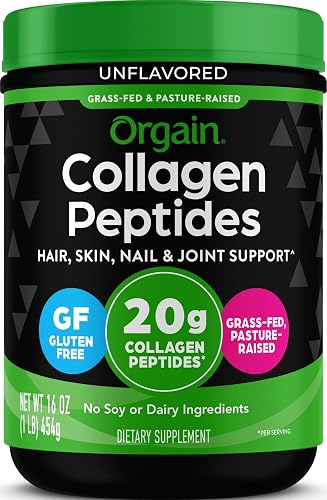
The most-reviewed collagen powder on Amazon by a wide margin, and the rating held up across nearly 40,000 verified buyers. Unflavored and grass-fed, it dissolves into coffee or a smoothie without leaving grit.
Best for: Anyone who wants the option with the deepest track record before committing.
Check Price on Amazon →2. Nutricost Collagen Peptides — Best Value

Lower collagen per scoop than the others, but that also means more servings per tub and the highest rating on this list. Grass-fed, gluten-free, and dissolves clean in water or juice.
Best for: Budget-conscious buyers who don’t mind a smaller per-scoop dose in exchange for more total servings.
Check Price on Amazon →3. Garden of Life Grass Fed Collagen Peptides — Best For Gut & Joint Support

Same 20g collagen dose as the flagship brands, but it also carries 250 million CFU of probiotics for digestion. Third-party tested, sourced from pasture-raised cows.
Best for: Anyone who wants joint and gut support in the same scoop instead of stacking two supplements.
Check Price on Amazon →4. Vital Proteins Collagen Peptides (Vanilla) — Most Popular Brand

The brand most people have already heard of, and the vanilla flavor actually mixes pleasantly instead of tasting chalky. Rating trails the others slightly, but it’s still a legitimate 20g dose from grass-fed, pasture-raised cows.
Best for: Anyone who wants a flavored option and doesn’t want to research an unfamiliar brand.
Check Price on Amazon →5. Micro Ingredients Hydrolyzed Collagen Peptides — Best Bulk Value

Double the size of most tubs on this list at a price that still lands below the premium brands. Unflavored, easy-dissolve, and sourced from Type I & III bovine collagen.
Best for: Regular users who go through a tub fast enough that bulk size actually saves money.
Check Price on Amazon →Type I vs. Type III Collagen: Does It Matter?
- Type I — makes up about 90% of your body’s collagen. Found in skin, tendons, ligaments, and bone. Most studied for skin elasticity and joint comfort.
- Type III — usually found alongside Type I in skin and blood vessels. Most bovine collagen powders (including every pick above) provide a blend of both.
- Hydrolyzed vs. gelatin — hydrolyzed collagen (what all 5 picks above use) is broken down into smaller peptides that dissolve in cold liquid and absorb faster. Gelatin is the same protein, just less processed, which is why it gels instead of dissolving.
- Marine vs. bovine — marine collagen (from fish) is almost entirely Type I and absorbs slightly faster in some studies, but bovine is cheaper and covers both Type I and III in one scoop, which is why it dominates this list.
FAQ
Does collagen actually help if you lift weights?
Collagen peptides paired with a training stimulus have shown improvements in joint comfort and connective tissue markers in several controlled trials. It’s not a replacement for muscle-building protein — for that, see our science-backed guide to gaining muscle.
Should I take collagen instead of whey protein?
No — they do different jobs. Collagen is low in the essential amino acids (especially leucine) that drive muscle protein synthesis, so it shouldn’t replace your post-workout shake. Compare options in our whey protein picks.
Does collagen support recovery the way other minerals do?
Collagen supports the connective tissue side of recovery, while minerals like magnesium support the muscular and nervous system side. See how magnesium supports muscle recovery for the other half of that picture.
Is there overlap between collagen and other minerals like zinc?
Yes — zinc is a cofactor in collagen synthesis, so a deficiency can blunt the benefit of supplementing collagen on its own. We cover that connection in our zinc benefits guide.
What’s the best time to take collagen?
Timing matters less than consistency — most studies dose it once daily, any time, for 8-12 weeks before measuring results. Coffee, a smoothie, or plain water all work since hydrolyzed collagen dissolves without clumping.
Final Verdict
For most people: Orgain Hydrolyzed Collagen Peptides. Nearly 40,000 ratings holding a 4.5/5 average is the deepest track record on this list, and the 20g dose matches what’s used in most of the joint and skin studies.
Want the cheapest way in? Nutricost or Micro Ingredients. Want gut support bundled in? Garden of Life. Already trust a name brand? Vital Proteins vanilla mixes better than most unflavored options.
Whichever you pick, give it 8-12 weeks before judging results — collagen turnover is slow, and a half-used tub in the cupboard won’t tell you anything.
Disclosure: As an Amazon Associate, I earn from qualifying purchases. This means if you click on a link and make a purchase, I may earn a small commission at no extra cost to you.
Want More Guides Like This?
Get evidence-based supplement & training tips delivered straight to your inbox. No spam, unsubscribe anytime.